

When you are responsible for a team, working out which health and safety courses UK businesses should prioritise can feel like a long list with no obvious starting point. Training budgets are finite, and you want every pound to count, both for keeping people safe and for staying on the right side of the law. The encouraging news is that a small handful of courses cover the risks most workplaces share, whatever the sector you are in.
The need is real and broad. Across Britain in 2024/25, an estimated 680,000 workers sustained a non-fatal injury at work, while 1.9 million reported an illness they linked to their job. Different risks call for different training, which is why a sensible plan usually means a considered mix of courses rather than a single catch-all. Below are the five we would point most businesses towards first, followed by a look at the wider training that can round out your approach.
Why invest in health and safety training for your staff?
Beyond the obvious goal of keeping people well, there is a legal thread running through all of this. The Health and Safety at Work etc. Act 1974 places a duty on employers to provide the information, instruction and training their people need to work safely, and several specific regulations build on that for particular risks. Good HSE training for staff is how you turn that duty into something real on the ground.
The business case stacks up too. Workplace injury and new cases of ill health are estimated to cost employers and the wider economy around £22.9 billion a year, before you count the disruption of lost days, recruitment to cover absence and the knock to morale when something goes wrong. Set against that, a well-chosen training programme is a modest and sensible investment.
There is a reputational angle as well. More and more clients, particularly in regulated and safety-critical industries, expect their suppliers to demonstrate a genuine safety culture, and a trained workforce is one of the clearest ways to show it. The courses below are where we would suggest most organisations begin.
1. IOSH Managing Safely: safety skills for your managers
If your managers and supervisors set the tone for how safely work gets done, this is the course that gives them the grounding to do it well. IOSH Managing Safely is a practical, widely recognised programme that covers assessing risks, controlling hazards, understanding responsibilities and investigating incidents, all framed around the realities of a working day rather than dense theory.
It matters because the law expects safety to be managed competently, and managers are usually the people making the day-to-day calls. Giving them a proper foundation reduces the chance of things slipping through the cracks and helps safety become part of how the team operates rather than an afterthought.
We deliver IOSH Managing Safely as a three-day course. For organisations that want to build awareness across the whole workforce rather than just the management layer, IOSH Working Safely is a one-day option that gives every employee a solid grasp of the essentials.
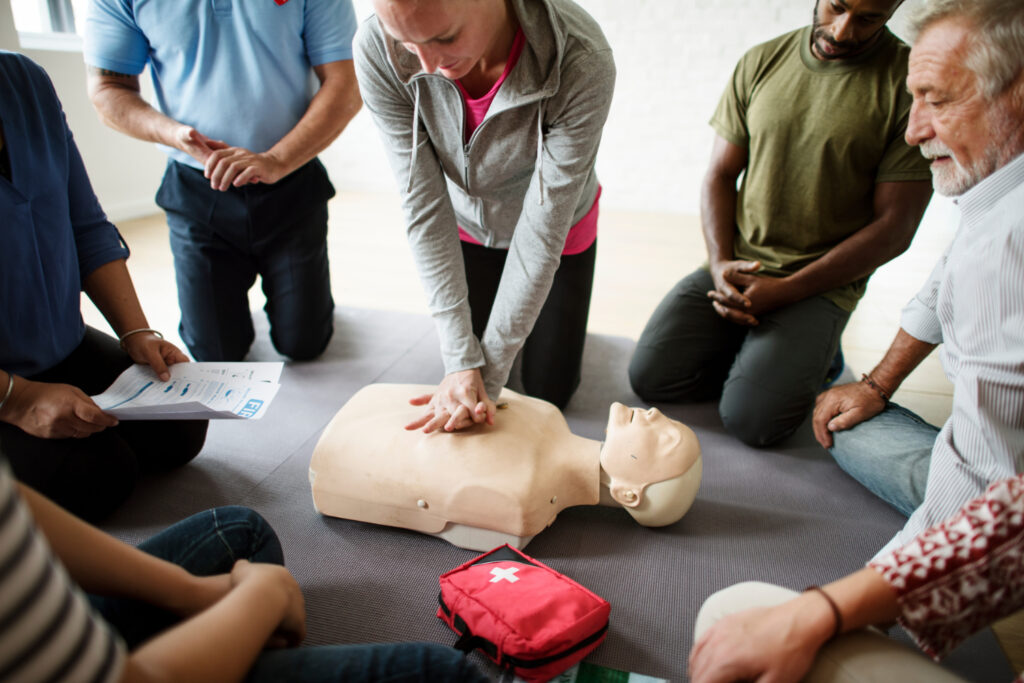
2. First aid at work: a legal duty and a lifesaver
First aid is one of the few areas where the law is unambiguous. The Health and Safety (First-Aid) Regulations 1981 require every employer to provide adequate and appropriate equipment, facilities and trained people so that anyone injured or taken ill at work receives immediate attention, and this applies to every workplace regardless of size. A first aid needs assessment helps you work out exactly how many first aiders you need and at what level.
The case for it goes well beyond compliance. In the minutes before an ambulance arrives, a trained colleague can be the difference between a manageable situation and a far more serious one, which is a reassuring thing for any team to have in place.
To match different needs, we offer Emergency First Aid at Work as a one-day course, First Aid at Work as a three-day qualification for workplaces needing fuller cover, and Paediatric First Aid over two days for those working with children. Certificates typically last three years, with an annual refresher recommended, so it is worth building renewals into your planning.
3. Fire warden training: staying on the right side of fire safety law
Fire safety is another clear legal duty. Under the Regulatory Reform (Fire Safety) Order 2005, the “responsible person” in a business, usually the employer or whoever controls the premises, must carry out a fire risk assessment, put suitable measures in place and appoint one or more competent people to help with fire safety. Those people are commonly known as fire wardens or fire marshals, and competence comes from proper training.
Beyond the legal box-ticking, a trained fire warden is the person who keeps a calm, orderly evacuation on track, checks escape routes and helps prevent fires in the first place. In a real emergency, that clarity is invaluable.
Our Fire Warden, or Fire Marshal, training runs as a one-day course and equips designated staff to carry out the role with confidence. For broader awareness across a team, Fire Awareness is a half-day session covering the fundamentals everyone should know.
4. Manual handling: tackling one of the most common injuries
Lifting, carrying and moving loads causes more harm than many businesses expect. Handling, lifting or carrying accounts for around 17 per cent of all non-fatal workplace injuries reported to the HSE, making it the second most common cause after slips and trips, and back and upper-limb problems can keep valued people off work for weeks. The Manual Handling Operations Regulations 1992 ask employers to avoid hazardous manual handling where they reasonably can, to assess what cannot be avoided and to reduce the risk.
Training is one of the most cost-effective controls available. When people understand how to assess a load, use the right technique and make use of any aids, the risk of injury drops considerably.
We run Manual Handling Basic as a one-day course suitable for most teams, and Manual Handling Train the Trainer over three days for organisations that want to develop their own in-house instructor. The latter is a practical option if manual handling is a regular feature of your work.

5. Mental health awareness: supporting wellbeing at work
Workplace wellbeing has moved firmly from a nice-to-have to a core part of health and safety, and the figures explain why. Stress, depression and anxiety affected an estimated 964,000 workers in 2024/25 and now make up the single largest cause of work-related ill health. Employers have a legal duty to assess and manage risks to health, and that includes mental wellbeing, not just physical safety.
Training helps managers and colleagues spot the early signs that someone is struggling, have a supportive conversation and point people towards the right help. That early intervention is good for the individual and tends to reduce absence and turnover too.
We offer Mental Health Awareness as a half-day introduction for any workplace, and Supervising First Aid for Mental Health over two days for those taking on a more formal role supporting colleagues. Both help build the kind of open, understanding culture that benefits everyone.
Other health and safety courses UK businesses should know about
The top five cover the risks most workplaces face, but they are not the whole picture, and the right plan depends on your sector and activities. Alongside the courses above, we also offer training that suits more specific needs.
For anyone building a career in safety, the IOSH Level 3 Certificate is a regulated qualification for new and aspiring safety professionals. Asbestos Awareness, delivered as a half-day course, is essential for trades and building work where asbestos could be disturbed, while Accident Investigation training over a day helps organisations learn properly from incidents when they happen. We also offer Human Performance, a one-day course exploring how people contribute to safety and error, which fits well in higher-reliability environments such as engineering and nuclear.
The sensible approach is rarely to book everything at once. It is to start with the legal essentials and the risks specific to your work, then build from there as your needs develop.
Frequently asked questions
Which health and safety courses are a legal requirement?
First aid provision and fire safety arrangements are the clearest legal duties, under the Health and Safety (First-Aid) Regulations 1981 and the Regulatory Reform (Fire Safety) Order 2005. Other training, such as manual handling and management courses, supports your broader legal duty to manage risks and train your people.
How often does health and safety training need refreshing?
It varies by course. First aid certificates typically last three years, with an annual refresher recommended, and fire safety training should be repeated periodically and at induction. As a rule, training should be reviewed whenever your risks, equipment or workforce change.
Can courses be delivered at our own workplace?
Yes. We deliver training both at our North West training centre and as in-house programmes at workplaces across England, which is often more convenient for teams and lets us tailor examples to your environment.
Final thoughts
Choosing the right training does not need to be complicated. A focused set of courses, covering competent management, first aid, fire safety, manual handling and mental wellbeing, addresses the risks the vast majority of UK businesses share, while keeping you on the right side of the law.
From there, you can layer in the more specialist training your particular work calls for. The aim is a workforce that is confident, capable and genuinely looked after, which is good for your people and good for the business.
If you are weighing up where to start, the most useful next step is a quick conversation about your team and the risks you manage.
Not Sure Which Courses Your Team Needs?
We would be glad to help you build a training plan that fits your business, your sector and your budget. Take a look at our full range of health and safety training courses, or get in touch for a friendly, no-pressure chat and we will help you work out the right priorities for your team.
Sources
- Health and Safety Executive (HSE), Annual workplace health and safety statistics 2024/25, published 20 November 2025: https://press.hse.gov.uk/2025/11/20/hse-publishes-annual-workplace-health-and-safety-statistics/
- Health and Safety Executive (HSE), Kinds of accident statistics in Great Britain (non-fatal injuries): https://www.hse.gov.uk/statistics/causinj/overview.htm
- Health and Safety Executive (HSE), First aid at work: https://www.hse.gov.uk/firstaid/
- GOV.UK, Fire safety in the workplace: https://www.gov.uk/workplace-fire-safety-your-responsibilities
- Institution of Occupational Safety and Health (IOSH), Managing Safely: https://iosh.com/qualifications-and-courses/courses/managing-safely